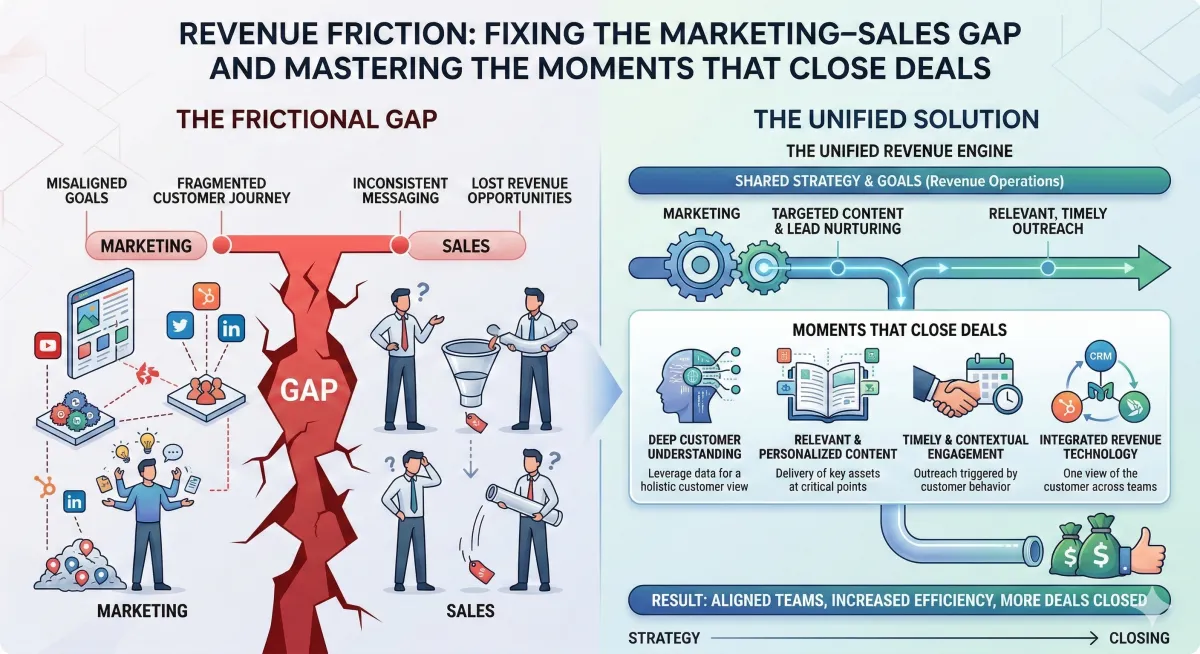
Revenue Friction: Fixing the Marketing–Sales Gap and Mastering the Moments That Close Deals
Most companies do not have a lead problem.
They have a handoff problem.
Marketing celebrates volume.
Sales complains about quality.
Revenue stalls in the middle.
This is where friction lives.
When marketing and sales operate as separate departments instead of a unified revenue engine, opportunity leaks between teams. Leads enter the pipeline with promise and leave with blame attached.
When Marketing Optimizes for Leads but Not for Sales
Marketing teams are typically measured by:
Cost per lead
Lead volume
Click through rates
Campaign performance
The focus is visibility and acquisition.
But without tight alignment with sales, marketing can unintentionally create:
Broad messaging
Weak qualification filters
Misaligned expectations
Leads without buying intent
Dashboards look strong.
Close rates do not.
When Sales Reacts Instead of Refines
Sales teams often respond with:
Slow follow up
Inconsistent qualification
Surface level discovery
Weak next step control
Instead of improving process, the easier narrative becomes:
“These leads are bad.”
Excuses replace ownership.
Momentum disappears.
Longer sales cycles and lower conversions follow.
The Hidden Cost of Misalignment
When communication breaks down, accountability breaks down with it.
Common friction points include:
No shared definition of a qualified lead
No structured feedback loop
Inconsistent CRM usage
No visibility into campaign to close performance
Marketing optimizes for traffic.
Sales optimizes for comfort.
Leadership wonders why revenue plateaus.
The Alignment Advantage
High growth organizations treat marketing and sales as one system.
That requires:
Shared Qualification Standards
Define exactly what makes a lead sales ready.
Closed Loop Feedback
Sales reports objections and patterns. Marketing refines targeting and messaging accordingly.
Integrated Data Discipline
CRM updates are mandatory. Clean data fuels smart decisions.
Consistent Communication
Weekly revenue focused meetings driven by metrics, not emotion.
Alignment increases efficiency.
Efficiency increases conversion.
The Post Call Discipline That Separates Top Closers
Most salespeople believe the work ends when the call ends.
Top closers know that the deal is won or lost in the follow through.
1. Reinforce the Immediate Impression
Send a concise recap.
Summarize:
Pain points discussed
Desired outcomes
Confirmed next steps
Clarity reduces doubt. Speed builds trust.
2. Run a Loss Prevention Audit
Review the conversation quickly.
Identify:
Objections not fully addressed
Missing stakeholders
Budget or timeline gaps
Fix vulnerabilities before they become roadblocks.
3. Map the Decision Structure
Update the CRM with insight, not surface notes.
Clarify:
Who influences
Who approves
Who can stall the process
Equip your internal champion with language that helps them advocate internally.
4. Lock in a Concrete Next Step
Never rely on vague follow ups.
Secure:
A calendar invite
A defined agenda
A specific commitment
Control the timeline or lose it.
Winning Attention in a Crowded Market
Attention is the gateway to revenue.
But visibility alone does not create growth.
Brands must:
Engineer strong positioning
Execute bold creative
Align messaging with funnel stages
Install performance tracking systems
Attention without structure becomes noise.
Attention with discipline becomes leverage.
The Real Growth Equation
Revenue accelerates when:
Marketing generates aligned opportunities.
Sales executes with precision.
Creative attracts the right audience.
Strategy directs every action.
Friction decreases.
Conversion increases.
Momentum compounds.
The companies that win do not chase more leads.
They eliminate the disconnect.
Looking to elevate your brand and accelerate growth?
Discover how Limelight Media helps businesses turn strategy into measurable results. If you want to see the frameworks behind scaling to six figures and beyond, check out the 100K Sales Program and explore what’s possible inside the program.
