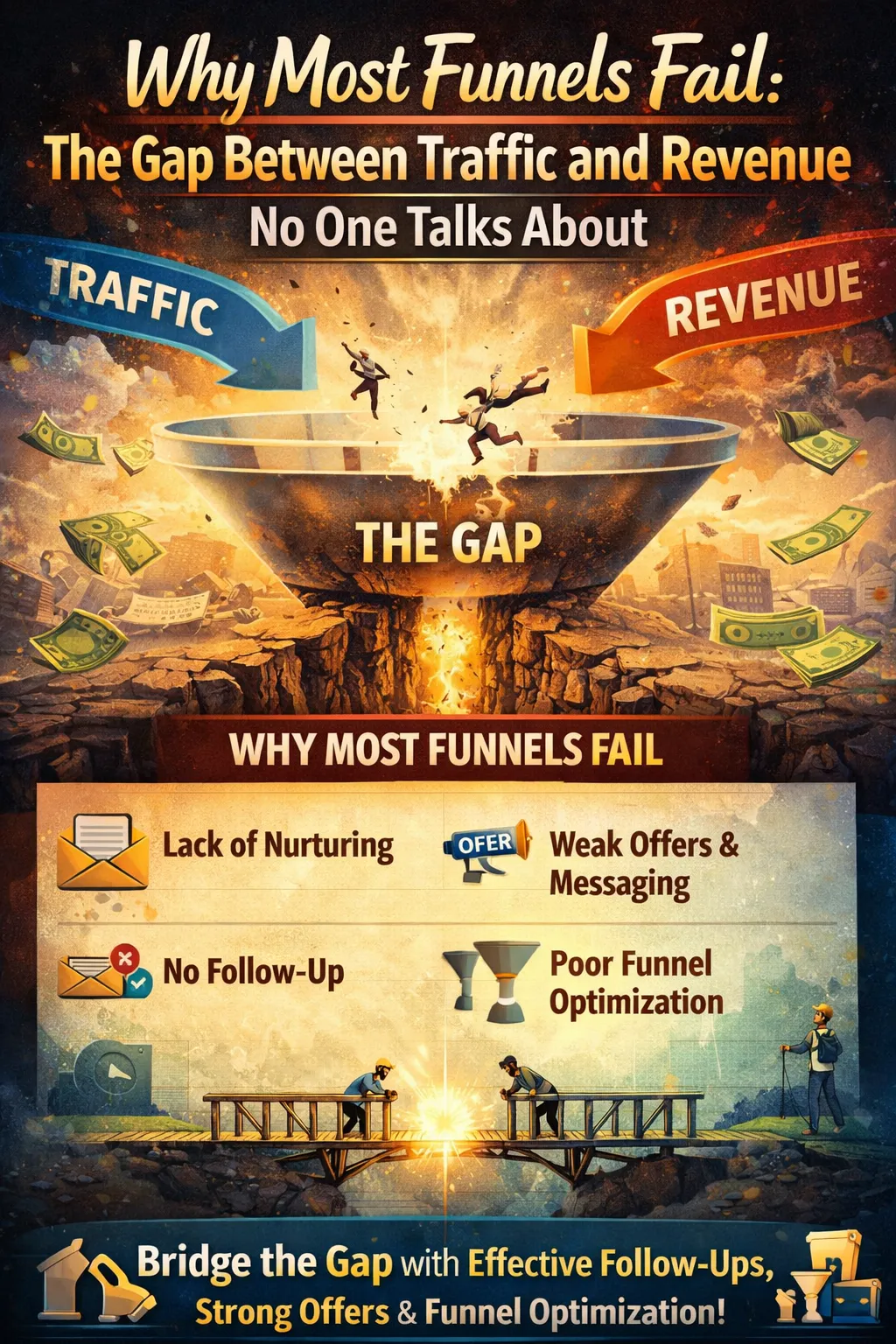
Why Most Funnels Fail: The Gap Between Traffic and Revenue No One Talks About
In the modern digital landscape, "traffic" has become the ultimate vanity metric. Businesses and entrepreneurs spend thousands, sometimes millions, of dollars on Facebook Ads, Google PPC, SEO strategies, and influencer partnerships, all for the dopamine hit of seeing a spike in their Google Analytics dashboard.
But here is the cold, hard truth: Traffic is a commodity; conversion is the business.
You can have a million visitors, but if your bank account isn't reflecting that volume, you don't have a traffic problem. You have a structural integrity problem. You are pouring expensive wine into a bucket riddled with holes. To turn the tide, we need to stop obsessing over how many people are coming through the door and start looking at why they are leaving through the back exit before they buy.
Traffic Is Just the Beginning: The Psychological Bridge
The most dangerous misconception in digital marketing is that a click equals a customer. In reality, a click is merely an invitation to start a conversation.
A funnel isn't just a series of interconnected URLs; it is a psychological bridge designed to move a complete stranger from a state of curiosity to a state of committed investment. Every step of that journey, from the initial ad copy to the post-purchase thank-you page, either builds trust or erodes it.
The Anatomy of Trust Erosion
When a user clicks an ad promising a "Simple Weight Loss Guide" but lands on a page filled with aggressive pop-ups, confusing jargon, and a 45-minute video that doesn't get to the point, trust is eroded. The "bounce" isn't just a stat; it’s a person deciding they no longer believe you can solve their problem.
To bridge the gap between traffic and revenue, you must audit the Landing Page Experience (LPX). Is the message consistent with the ad? Is the load time under three seconds? Is the "Ask" appropriate for the level of relationship you’ve built? If you’re asking for a $2,000 sale on the first page, you’re trying to get married on the first date.
The 3 Most Common Funnel Killers
If your revenue isn't matching your effort, one (or all) of these three "killers" is likely lurking in your system.
1. Weak Offer Structure (The Clarity Gap) Most businesses don't have a product problem; they have a communication problem. You might have the best software, the most transformative coaching, or the highest-quality physical product, but if your offer structure is weak, it won't sell.
A weak offer often suffers from "The Curse of Knowledge." You are so close to your business that you use "insider language" that confuses the prospect.
The Fix: Your landing page must answer three questions in the first five seconds:
What do you do?
How does it make my life better?
What do I need to do next?
If your "Call to Action" (CTA) is buried or vague (for example, "Learn More" versus "Get My Free Guide Now"), you are creating friction. Clarity beats cleverness every single time.
2. Misaligned Traffic (The Broken Cup Syndrome) Bringing the wrong audience into a funnel is like pouring premium gasoline into a diesel engine. It doesn't matter how high the quality is; it’s the wrong fit.
Many brands fall into the trap of chasing "cheap clicks." They target broad interests to lower their Cost Per Click (CPC), but they end up with a funnel full of "looky-loos" who have no intention, or no budget, to buy.
The Fix: Alignment starts at the source. Your ad copy should act as a filter, not just a magnet. It should repel the wrong people just as effectively as it attracts the right ones. If your product is for high-end enterprise CEOs, your ad should use language that resonates with that specific demographic, even if it makes the "average" person scroll past.
3. No Strategic Follow-Up (The Abandoned Revenue) Statistically, only 2% of web traffic converts on the first visit. That means 98% of your ad spend is effectively wasted if you don't have a system to bring people back.
Most funnels "leak" here because they lack a sophisticated backend. If someone opts into your lead magnet but doesn't hear from you for three days, the lead is cold. If they abandon their cart and don't receive a reminder, they’ve likely forgotten you exist.
The Fix: Implement an automated "Indoctrination and Sales" sequence. Use email marketing, SMS, and retargeting ads to stay top-of-mind. A healthy funnel understands that the sale happens in the follow-up.
Optimization Is an Ongoing Process, Not a One-Time Fix
One of the most expensive mistakes a brand can make is the "Set and Forget" mentality. They hire an agency to build a funnel, launch it, and then walk away to focus on the next project.
In reality, a funnel is a living asset. It is a laboratory where you test hypotheses. The brands that scale to seven and eight figures aren't lucky; they are disciplined about data.
The Power of Marginal Gains
In mathematics, the principle of marginal gains suggests that if you improve every area of your funnel by just 1%, the cumulative effect is massive. Consider this:
Improving your Opt-in Rate from 20% to 25%.
Improving your Email Open Rate from 15% to 20%.
Improving your Sales Page Conversion from 1% to 2%.
These small tweaks don't just add up; they multiply. By the end of the chain, you haven't just seen a 5% increase in revenue; you’ve often doubled your ROI.
What to Test First?
Don't guess. Look at your "Drop-off Points." If 90% of people leave on the first page, test your headline. If people get all the way to the checkout but don't buy, test your shipping costs or add "Trust Signals" like SSL badges and money-back guarantees.
What a Healthy Funnel Actually Looks Like
A healthy funnel feels less like a sales pitch and more like a guided tour. It should have the following characteristics:
Congruency: The "Vibe" and the "Message" remain consistent from the Facebook ad to the final checkout. No "bait and switch."
Objection Handling: It anticipates the user's "Yes, but..." (for instance, "Yes, but I don't have time," or "Yes, but will this work for my industry?") and answers them through FAQs, testimonials, and case studies.
Frictionless Path: It makes the "Next Step" feel like the most logical thing in the world.
Value-First Approach: It provides value even if the person doesn't buy. This builds "Brand Equity," ensuring that when they are ready to buy, you are the only name they consider.
Ready to Take the Next Step?
Looking to elevate your brand and accelerate growth?
Discover how Forward Creative helps businesses turn strategy into measurable results. If you want to see the frameworks behind scaling to six figures and beyond, check out the 100K Sales Program and explore what’s possible inside the program.
